Tree FAQ
I came across some excellent resources to guide a homeowner in selecting trees for their landscape. It occurred to me that the terms might be confusing to someone who wasn’t experienced in gardening, and thought I add in my own two cents to the conversation.
(1)
The first resource is Northern Gardening’s article, Selecting the Right Tree for Your Home Landscape by Terry Yockey (who has had a valuable garden website for a long time- this man knows his stuff!). He tells you, in detail, to consider:
Terry's advice for selecting trees
Hardiness. Most garden centers will replace a tree that doesn’t make it through the first year–but do you really want to start all over again the next season? Even worse, you could end up losing a marginally hardy tree after many years and a particularly harsh winter. It’s regrettable, but just because a tree is sold in the North—that doesn’t always mean that it is dependably hardy in the North.
If you aren’t sure that a species or variety of tree is reliably hardy, call your local Extension Office for their recommendation.
Ornamental qualities. When I plant a new tree, I look for a species and variety that not only flowers in the spring, but also has attractive fruit or seeds that attract wildlife, good fall color and attractive bark for winter interest. You may not be as particular as I, but when choosing your own tree it is important to research the bad characteristics as well as the good ones. Some things to look for are a tendency to sucker (have basal or root sprouts), flowers or foliage with an unpleasant odor, thorns or spines, and fruit or seeds pods that can litter your yard and become a nuisance.
Available space. The location you choose for your tree should have enough space to allow for growth without severe pruning. If you have utility wires or any other overhead obstacles you should limit your choices to low-growing species. Avoid planting a tree with a large crown in a spot where it will eventually interfere with your visibility or come into contact with the side or roof of your home.
Soil conditions. Trees are very sensitive to the pH of the soil. A good example would be growing sugar maples in Minnesota. Because sugar maples like a soil that is slightly acid, they often become stressed when planted in our overly alkaline soil. Ultimately, this can cause them to be more susceptible to pests and diseases. A soil test will help you find a tree that will thrive in your particular soil’s pH.
Drainage is another important consideration. If your yard is poorly drained, you must either choose a tree that tolerates a consistently wet soil or make some adjustments to the site.
Shade tolerance. It’s just common sense—don’t plant a sun-loving tree in a shady location—it won’t do well. Growth rate and longevity. Be aware that it is usually a trade-off when you buy a tree that grows quickly. Although you will have a mature tree more rapidly, most fast-growing trees are short-lived and have brittle, weak branches that are easily broken or damaged by storms.
Water requirements. If you don’t have an irrigation system or easy access to a water supply, you shouldn’t plant a species of tree that requires a moist soil (willows are one good example). The opposite is also true. Don’t plant trees that have low water needs in heavily irrigated lawn areas or at the bottom of a slope where water collects.
Pest resistance. Some tree species or cultivars are extremely susceptible to insect or disease pests, while others are relatively pest-free. By choosing pest-resistant cultivars, you will save yourself a lot of time and money trying to do damage control later.
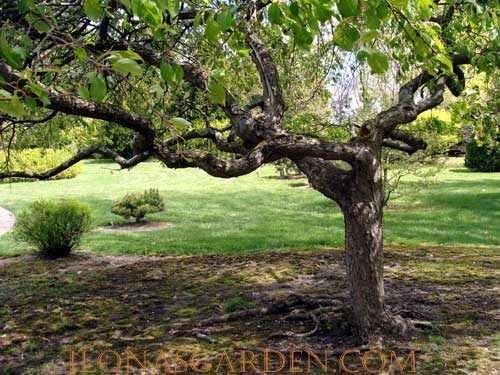
Trees may be pruned to shape, but choose one that will mature to the height that fits its space properly..
The Main Considerations
- Hardiness
- Ornamental qualities
- Available space
- Soil conditions
- Growth rate and longevity
- Water requirements
- Pest resistance
Tips to Choose the Right Tree
- Hardiness is one characteristic that determines whether the money spent and time involved in growing a tree was well invested. One very cold winter could spell the end of your tree.It is easy to find the zone you are in on a hardiness map, and if the nursery doesn’t have the tree labeled (unusual), any tree identification or profile should list it. Ohio ranges from zone 5 to 6
- There are trees with shapes that are narrow (look for the word ‘fastigiate‘), dwarf, or wide spreading. A tree that fits its space requires less pruning and is healthier.
- Soil conditions are very important since the tree will be there a long time -they live longer than we do, in most cases. Drainage, pH, and fertility, as well as type of soil (clay or sandy, etc) all matter to a tree.
- Do you live in an area that suffers droughts? Then a tree that is native to swampy areas is not a good choice. Check the information on the origination of the tree; the native conditions tells you much of what a tree likes.
- Not all trees take a long time to grow, and not every tree is likely to live a long time. I chose a sand cherry for a part of my garden , and it was quite beautiful for a long time, but then it became ragged, died, and now it is gone. It lasted perhaps 15 years.
- Some trees just thrive no matter what, but many require their need for water to be well-tuned. The trouble with larger trees is that they don’t show their stress right away, and take time to die from conditions that were poor several years earlier. Match the tree with the moisture profile of the climate; evergreens will be more sensitive to variations in their requirements.
- Pest resistance becomes extremely important when an invasion comes to your neck of the woods. The sword of Damocles hangs over those who plant the Ash trees, ever since the Emerald borer arrived in the USA.
Now, for your Viewing Pleasure
(2)
The second resource to help you make the best choice is this video from Backyard Farmer, which was attached to that article, I’m going to explain a few of the terms and some of the advice found in this video
What Do Landscapers Mean By That? FAQ for You
Quick growth? Big size?
Lots of people fall into the trap of wanting instant gardens… they plant too close or plant a tree that gets big quickly. Why is that not always a good choice? Many of the quickly growing trees are weak, and fail in high winds and storms… they either lose large branches or perhaps a whole side of the tree in normal storm conditions.
Silver maples and Bradford pears are examples of this type of tree. They have their use, but are they really right for you? Did you know that many trees have growth patterns? Some shoot up right away, others take their time in their youth and then have a “growth spurt”.
If you plant something that gives good growth after a few years in the ground you might have a better tree that gives you more longlasting satisfaction than if you settled for the fast grower that is disfigured by damage or just doesn’t have all the qualities that another species might have had for your situation.
What’s the problem with ash trees?
Unfortunately, we have imported a problem insect called the Emerald ash borer. It will eventually reach and kill your ash tree, because as of now there is nothing that can be done to prevent the spread of these insects and the damage they cause.
What is a street tree?
A street tree has certain qualities that people desire when they have sidewalks: no nuisance seeds or peeling bark, no undue excess of leaves. A good street tree stays healthy under urban conditions of pollution, their roots don’t lift the sidewalks, and they aren’t prone to breaking in storms. The thornless, seedless honey locust is an example (there are types that have both wicked thorns and large seed pods… those wouldn’t qualify as a good street tree!)
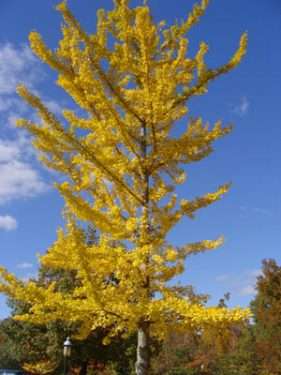
Gingko tree grow quite upright. It is a good street tree if you make sure it is not going to produce fruit.
Leader, …branching… size of the tree
The leader is the main upright growth of the tree. Trees often have competing leaders, but this is usually not desirable. If a second leader starts to develop it should be removed. Branching gives the tree balance and trees can be pruned to encourage better habits, but a naturally balanced tree is preferred.
It seems logical that the larger a tree is when you plant it the larger it will be in a few years, but trees aren’t logical. They are, but in a different way. Trees with good roots that become well established are going to be the better and healthier growers, so when planting a tree the proportion above ground is not as important as those life supporting roots underground.
Don’t worry about planting whips (young trees with that skinny single leader), since it doesn’t take long for them to catch up nicely to that more expensive “show off” of a tall tree with little root… and then surpass them.
“Understory”, what is that?
In the forest, where trees congregate, the upper story trees are the tall ones that reach the sunlight first. The understory trees are happiest in the shelter and shade of those upper story trees. Dogwoods, Japanese maples, and Serviceberry trees are examples of understory trees. They are favored for gardens because they remain in bounds with a shorter profile.
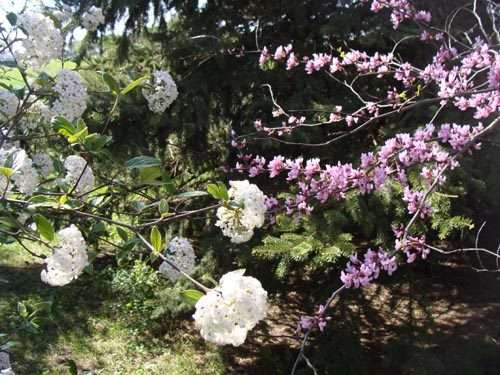
The Redbud (pink blooms) is an understory tree
How do you find out about your soils?
Trees can be particular about soil, and you need to know if your choice will grow well in the conditions of your property. Is the soil full of clay or sandy? Is it acid or alkaline? These conditions affect the tree. How well drained is the desired spot?
Take a look at your garden dirt, grab a handful of it. Does it clump together or is it loose and crumbly? does it have a hard time holding together? This will help you to know if it is clay, loam or sandy soil.
If you want to be accurate call your extension agent, see if you can procure some detailed information on your garden’s soils. Buy a soil test kit and run your own little experiment to find out the pH, and a few other important facts. If you are ambitious to know more or to provide your kids with a science experience.
These posts will answer your questions:
- Soil FAQs
- Dig Your Soil
- Resources to discover more about your soil
Extras for Landscape Knowledge
Great Sources on How To Prune USDA article, detailed with illustrations.
PDF from Purdue U. to print out
How and When -short, but helpful article.
 Get the best pruner you can afford and one that is kind to your hand. This one by Felco is one of the best. I own several sizes of this brand.
 This book is highly recommended.
These books will help: